Trans-Sierra Backpacking - Day 2
Explore Landscapes #120
Day 2 of the Trans-Sierra backpacking route took us from Ferguson Creek / Sugarloaf to Big Wet Meadow / Cloud Canyon [10.33 miles / 2,244 ft ascent / 636 ft descent]
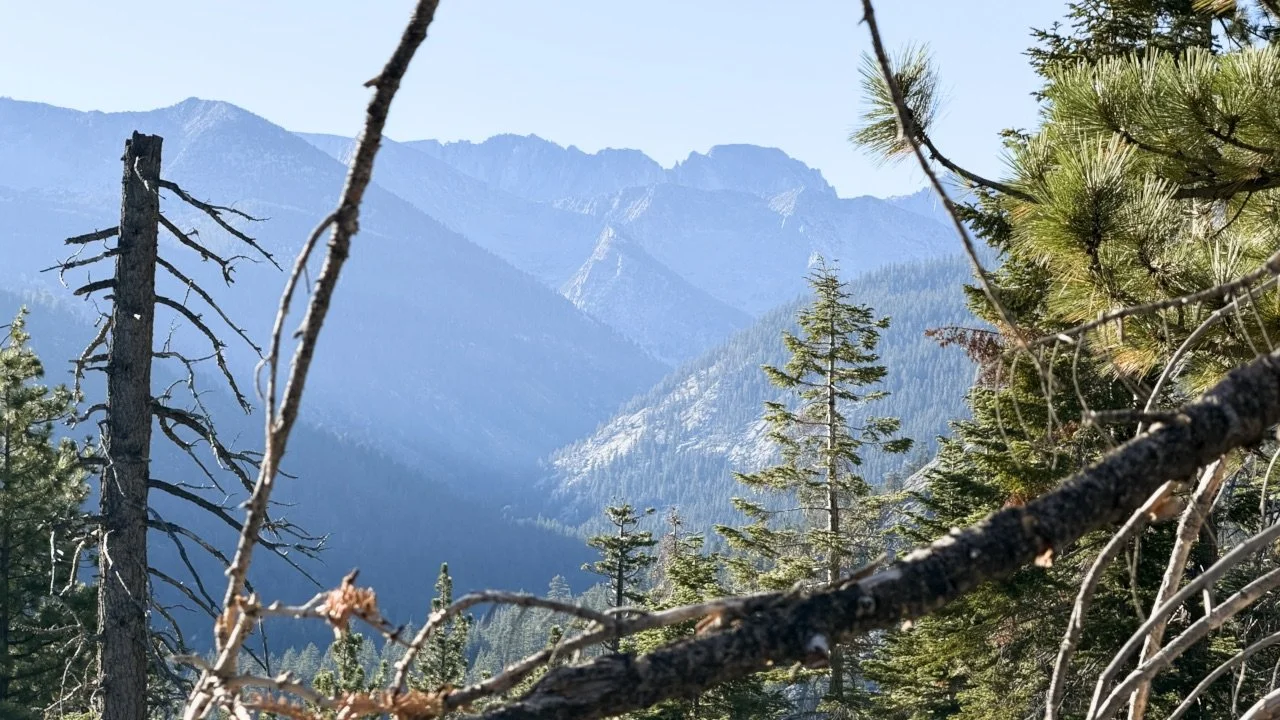
Horn Peak, Big Bird Peak and Winter Alta from the Sugarloaf Valley Trail | © 2026 Jon Norris
Introduction
I just backpacked across the Sierras, through Kings Canyon and Sequoia National Parks, on a Trans-Sierra Xtreme Challenge (TSX) trek with the Reciprocity Rx™ team. Reciprocity Rx™ is the brainchild of Sydney and Barry Williams (aka Hiking My Feelings® and WITW Consulting).
Over the next few weeks I’m going to publish a post for each day of the trek featuring route descriptions and reflection prompts from Sydney Williams, my responses to those prompts, plus exerts from my journal that I kept during the trek. In those responses I’m opening myself up, and being 100% authentic and real, so please be kind. Plus, of course, I’m including images that I took along the way.
As a landscape photographer it was a hard decision for me not to take my ‘big’ camera with me. As I was hiking with a group, I knew that I’d only be able to take snapshots throughout each day, and that I’d be carrying supplies for eight days, so adding 5+ lbs in weight made no sense. Consequently, all images were shot on my iPhone 17 Pro Plus.
NOTE: trekking miles and ascent / descent varied significantly between the GPX route files (whether viewed on AllTrails or Gaia GPS) and the data that my Garmin Fenix 7X recorded as I was trekking (it varied by 15 miles over the 8 days). I’m going to be using the Garmin data in the posts. I’m going to do some digging to try and figure out why this might be. I’ll share what I find out!
Here’s the previous days posts for this backpacking trip in case you missed them:
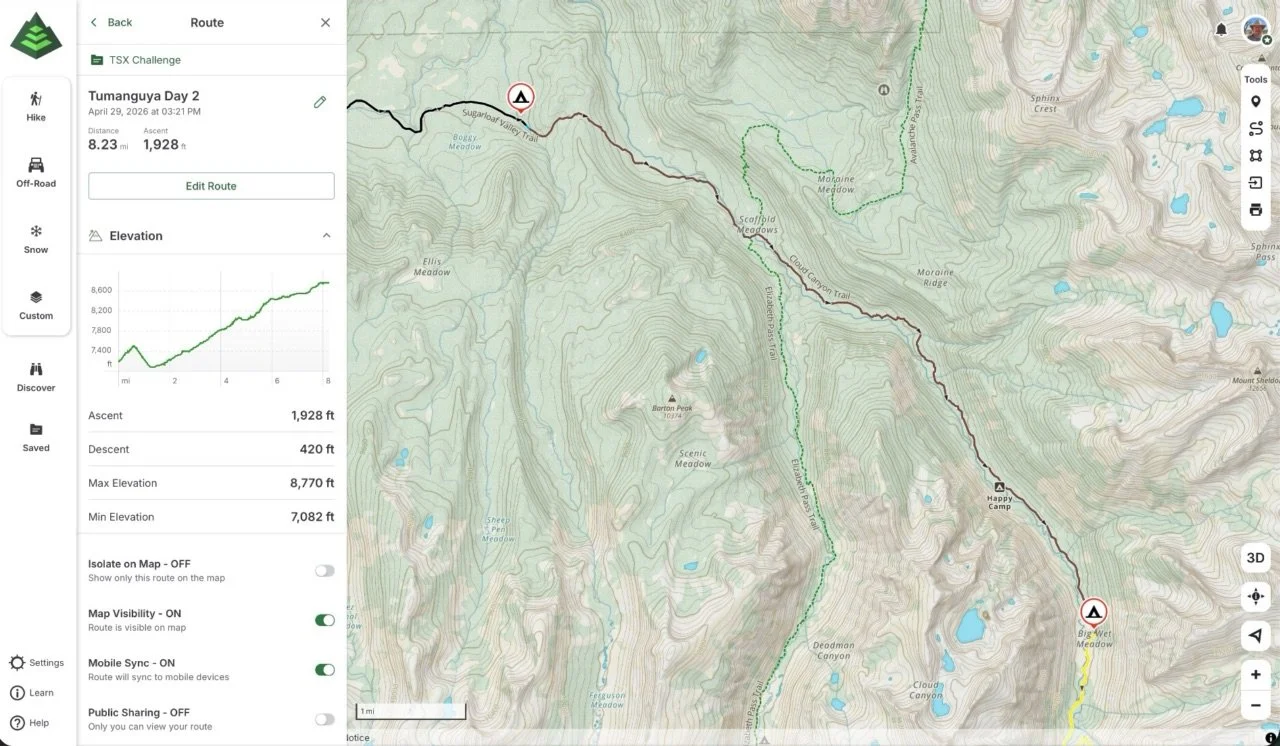
Tumanguya (Mt. Whitney) Backpacking Route - Day 2
Day 2’s Route Guidance
From Sydney Williams, “Day 2 invites us deeper into the wilderness, following the Roaring River corridor before turning toward Cloud Canyon and the Whaleback.
Today’s theme is: Be Held.
We’ll continue along the river, pass the ranger station, cross into new territory, and move toward the cradle of Cloud Canyon — a massive glacial canyon where walls rise thousands of feet overhead. The landscape begins to feel less like something we are passing through and more like something we are inside of.
Look for the way the river guides the day: cooler air, greener edges, denser vegetation, meadow openings, and the sound of water moving beside us. Notice the transitions between forest, river corridor, meadow, and canyon wall.
Today’s invitation is to consider what it means to be held by a place. Not rescued. Not fixed. Not promised ease. Held.
As the canyon rises around us, let the land remind you that support can still include effort. You can be tired and supported. You can be uncertain and held. You can be doing something hard and still be exactly where you belong.
Today’s reminder: let the river guide you, let the canyon hold you, and let yourself receive support without needing the day to be easy.”
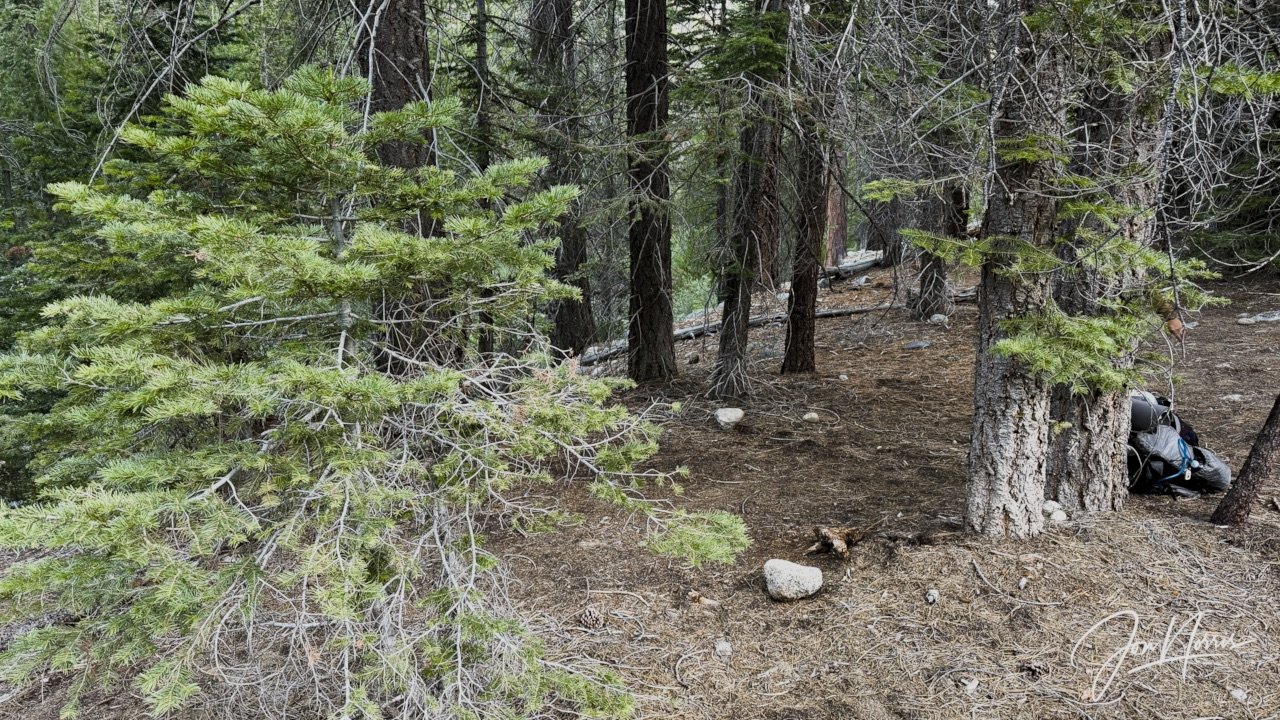
The pine needles and soft forest floor made for a comfortable night at Ferguson Creek | © 2026 Jon Norris
Trans-Sierra Backpacking - Day 2
I slept badly last night, mainly due to the exertion from day 1—and from my jet lag which I was still trying to shake off. My body clock was very confused—in fact it was broken. Dawn was a welcome arrival, as my hips were aching and I needed to get up and move. I knew it was early as there was no light. It was 4:30am, and I began eagerly searching out coffee to start my day. Fortunately Chris had the stove on to boil water and I enjoyed my first cup of coffee in the dark as I came to.
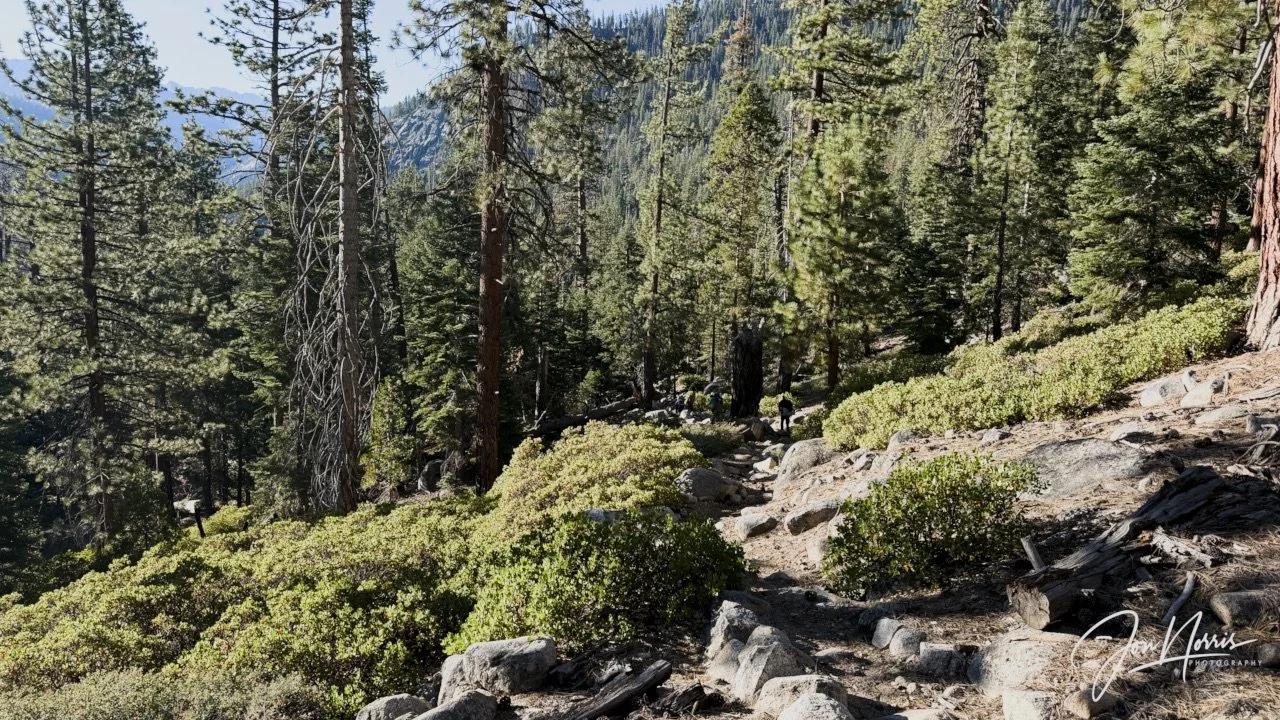
Looking back down the Sugarloaf Valley Trail as I take a breather and a few photos | © 2026 Jon Norris
I struggled to get into a good walking pace this morning, and with all the stops/starts to allow the group to come together, it made it feel harder that it needed to be.
As we following the Sugarloaf Valley Trail uphill we could hear the Roaring River starting to get louder as drew parallel with it. I’m assuming that once upon a time there was stock held near the river as there were various signs around to shut gates, although the gates wouldn’t have stopped anything from getting through in their now dilapidated state.
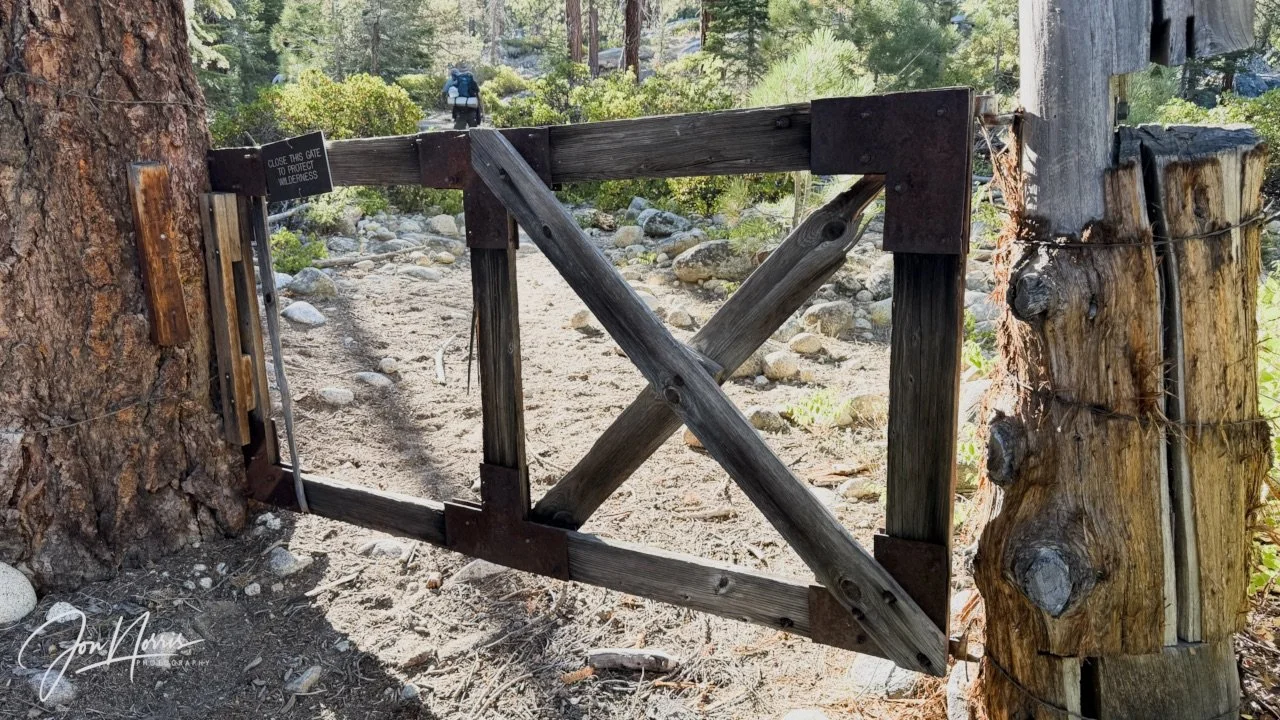
Not sure that closing this gate is going to keep much out | © 2026 Jon Norris
It was very hot so every river crossing was very welcome. At each and every opportunity I soaked my bandana and cap, enjoying the cold water soaking my head and torso. This brought refreshment for about 20 to 30 minutes until all of the cold water had evaporated.
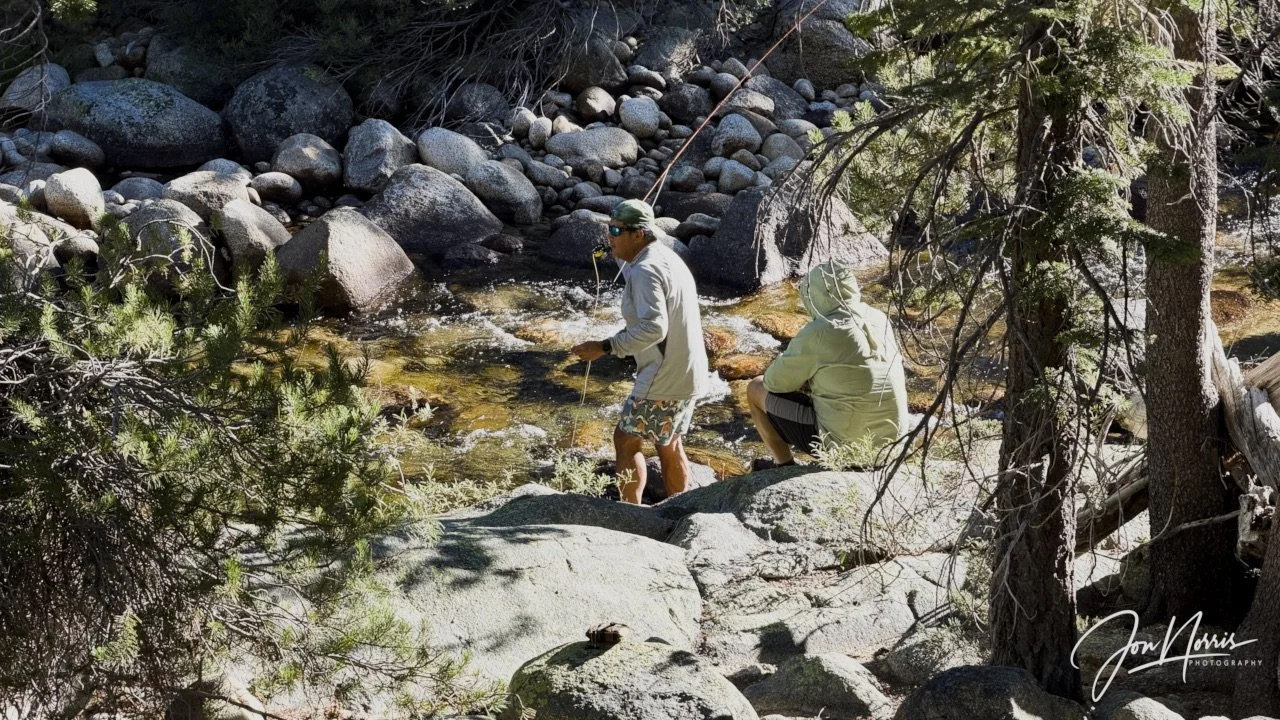
My friend Kevin in his element, fly fishing in Roaring River | © 2026 Jon Norris
A couple of the team members were keen fly fisherman, and it was great to see my Friend Kevin absolutely in his element fly fishing in Roaring River. He had a huge grin on his face the whole time he was fishing, and did catch a few fish, however, they were small, so were released right away.
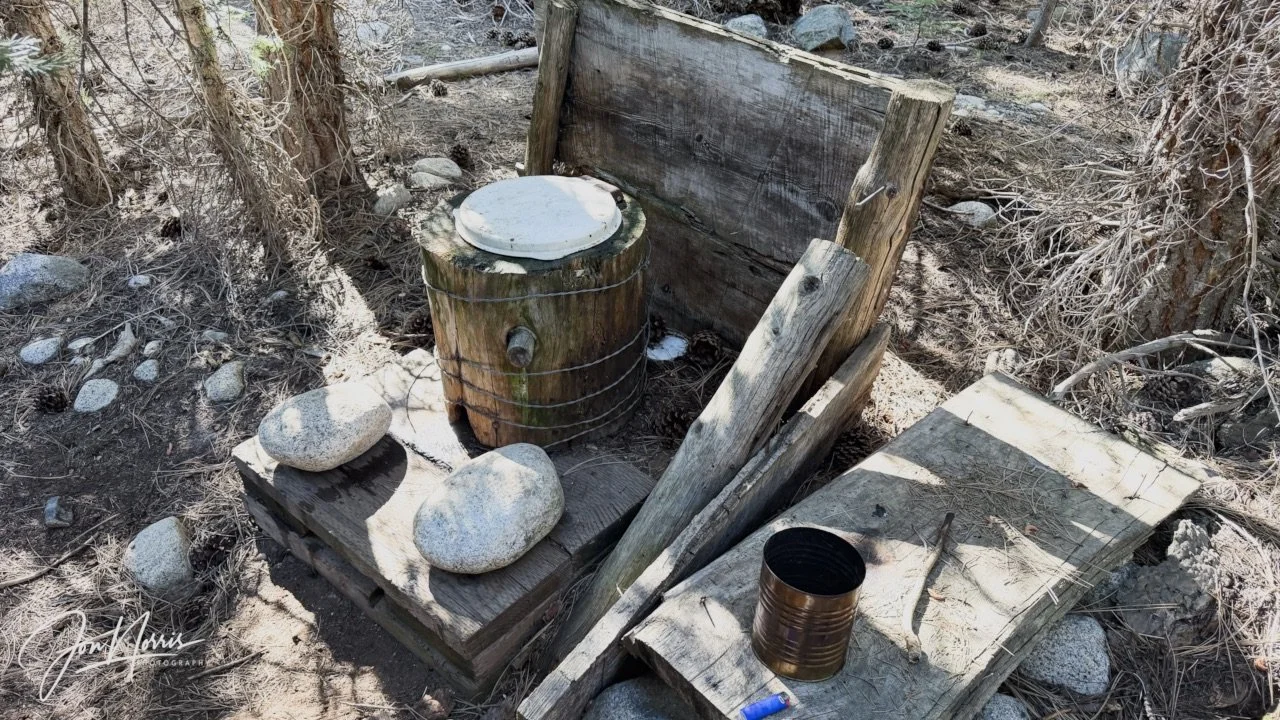
Backcountry luxury bathroom near the Ranger Station by Elizabeth Pass / Cloud Canyon Trail junction | © 2026 Jon Norris
When you’re backpacking life is stripped back to the absolute basics. We were (of course) practicing Leave No Trace so everything (absolutely everything, including used toilet paper) was packed out.
We’d heard about a backcountry toilet near the Ranger station so of course we had to go and try it out. The large tin can was there so you could burn your used toilet paper.
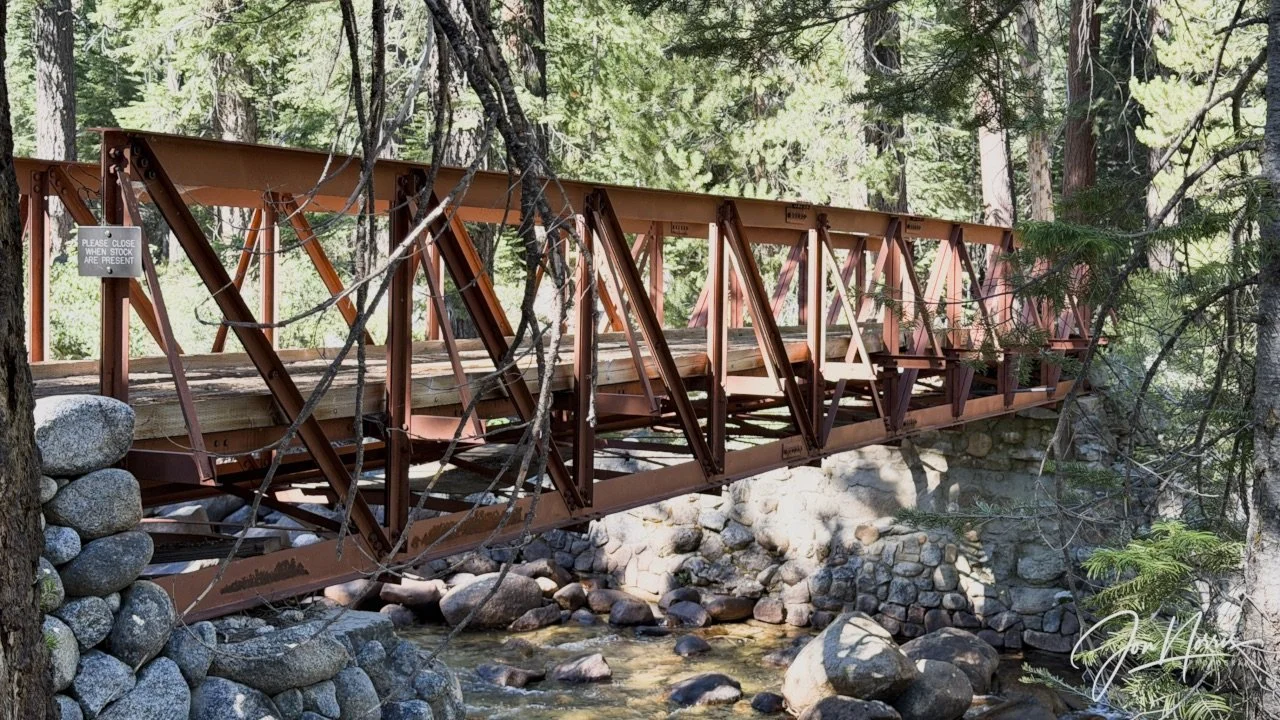
The only man-made bridge we saw on our trail that crosses Roaring River | © 2026 Jon Norris
Over the course of the 8 days of our backpacking trip we only saw a single man-made bridge (over the Roaring River). We had plenty of river crossings—most of which were easy to criss without getting wet.
However, if there was an opportunity to wade into a cold river to cool off, we took that opportunity. I don’t like hiking in wet trail shoes so had some strap sandals that doubled as camp shoes. It felt so good to soak your feet in the cold water and then put your trail shoes back on when you got to the other side.
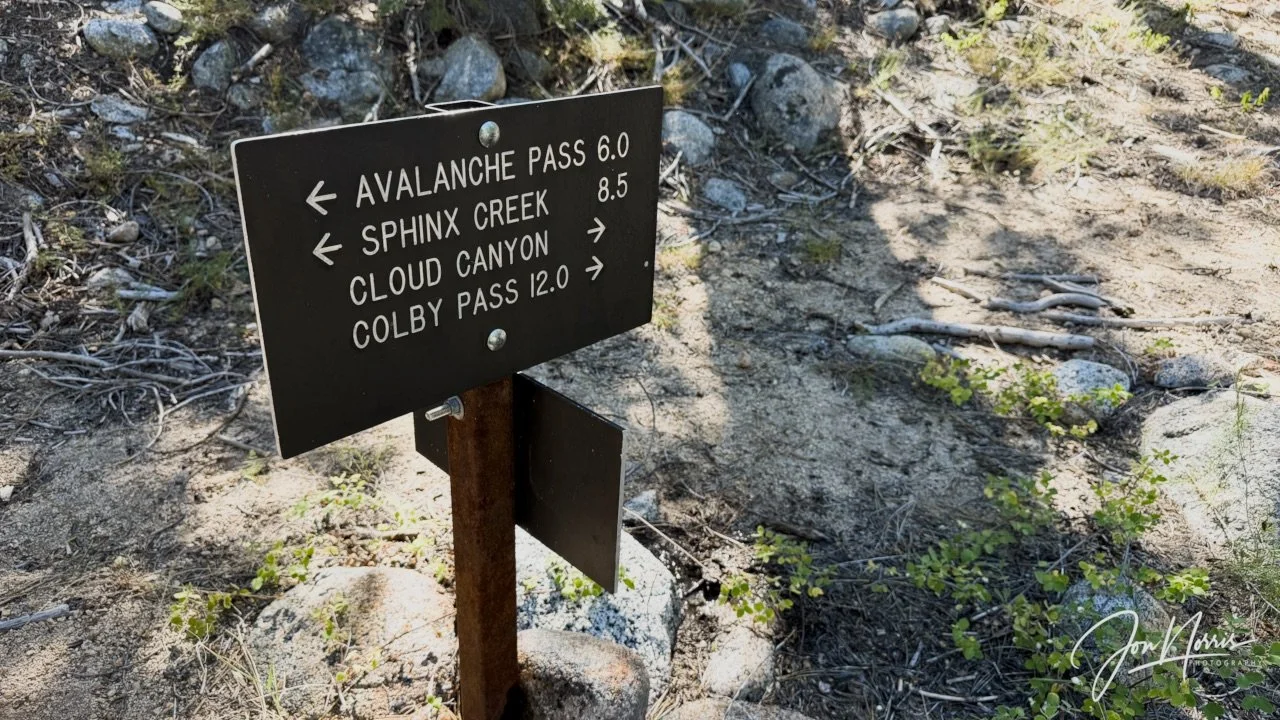
A sign of things to come: Cloud Canyon and the Colby Pass | © 2026 Jon Norris
The trails that we were following were very well marked, and for the most part, I almost never needed to refer to a map. We were going to be following Cloud Canyon up to Big Wet Meadow today, then going to Colby Lake on day 3, followed by Colby Pass on day 4.
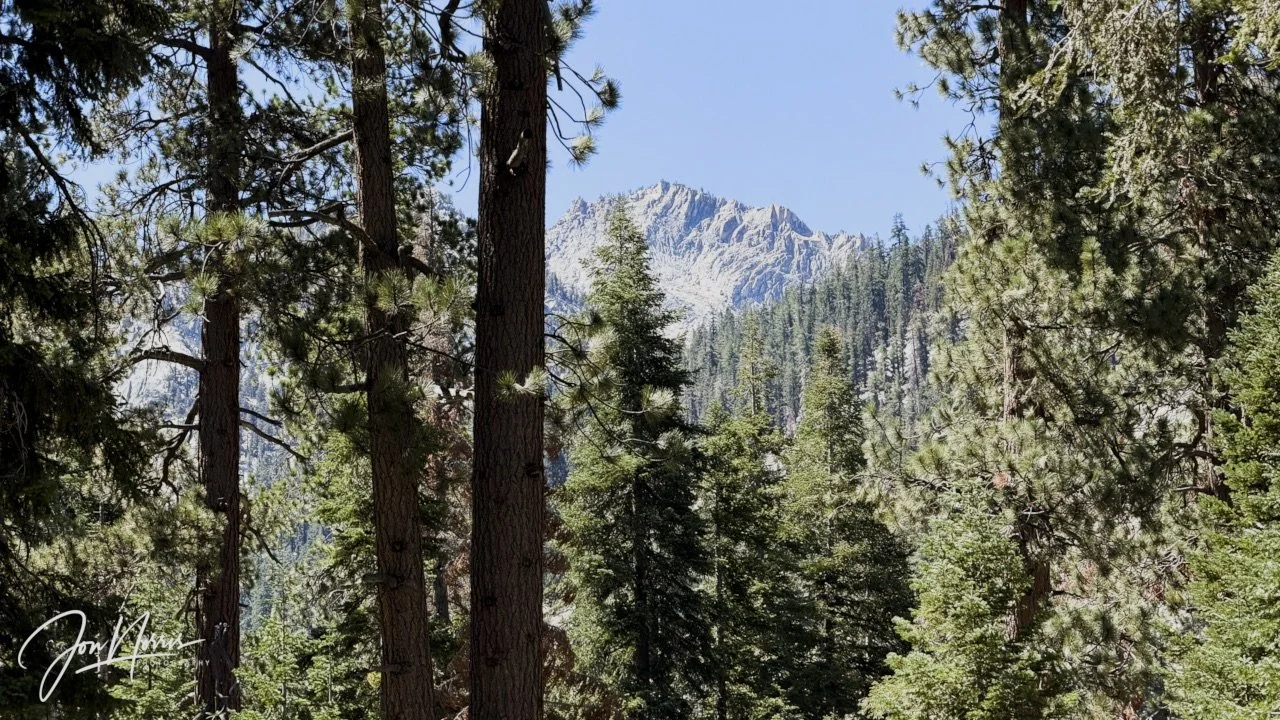
Video: Roaring River | Image: Barton Peak from the Cloud Canyon Trail | © 2026 Jon Norris
I stopped frequently to enjoy the incredible views of the huge granite peaks that we see on both sides of the Cloud Canyon Trail. All the time we were serenaded by the sound of Roaring River.
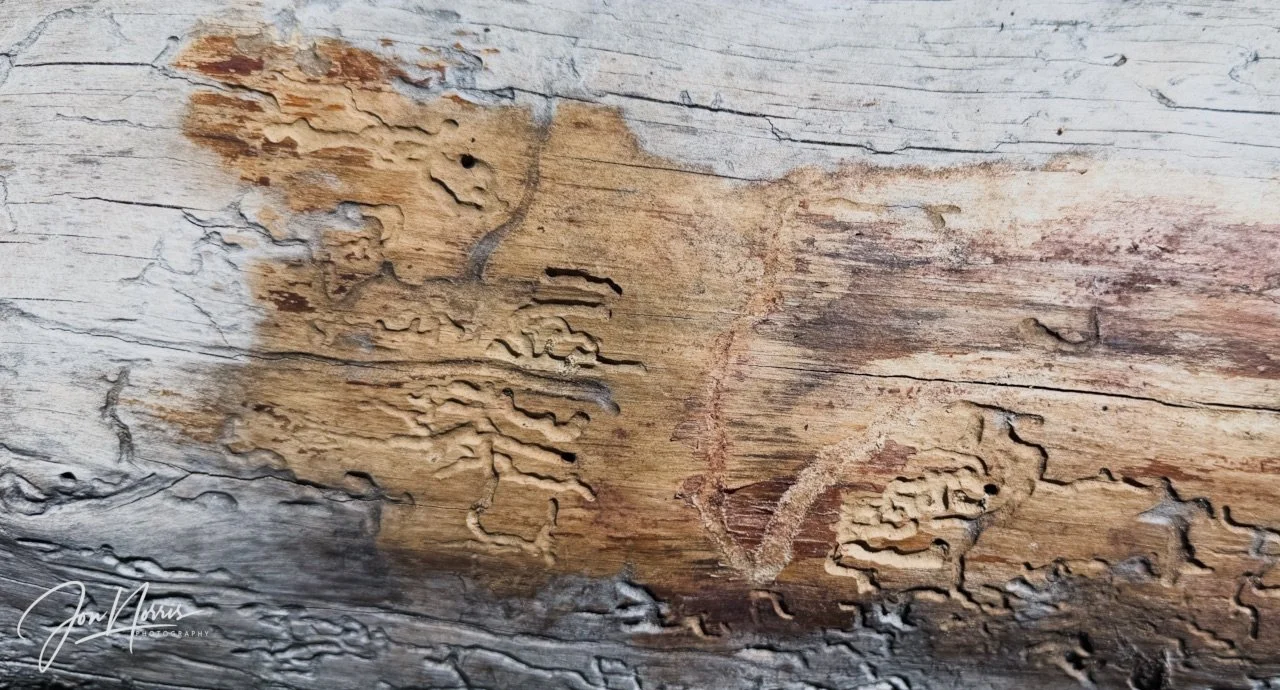
Termite trail ‘art’ in a downed tree trunk | © 2026 Jon Norris
I spent a lot of time today looking out for the little details on a trail that I find so fascinating. There were a lot of downed trees in various states of returning to nature and being consumed by the ground beneath them.
There were termite trails (that’s what I assumed they were) that looked like fine engraving on a precious material. The fir trees (which were predominant along the trail) came in all kinds of colors and textures.
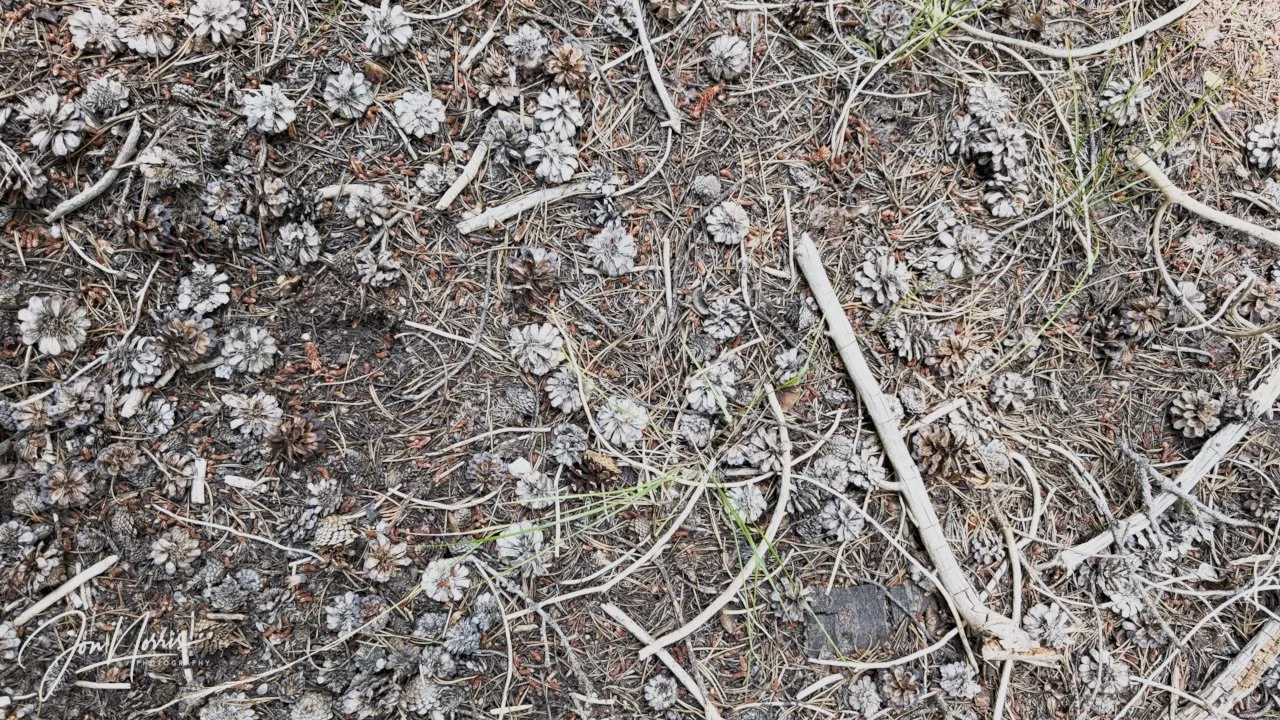
The beautiful and chaotic complexity of the forest floor | © Jon Norris
I was fascinated by the beautiful and chaotic complexity of the forest floor and how so many different materials had come together to form a natural carpet. Pine needles, pine cones, sticks, branches, and leaves formed an aromatic, soft trail underfoot.
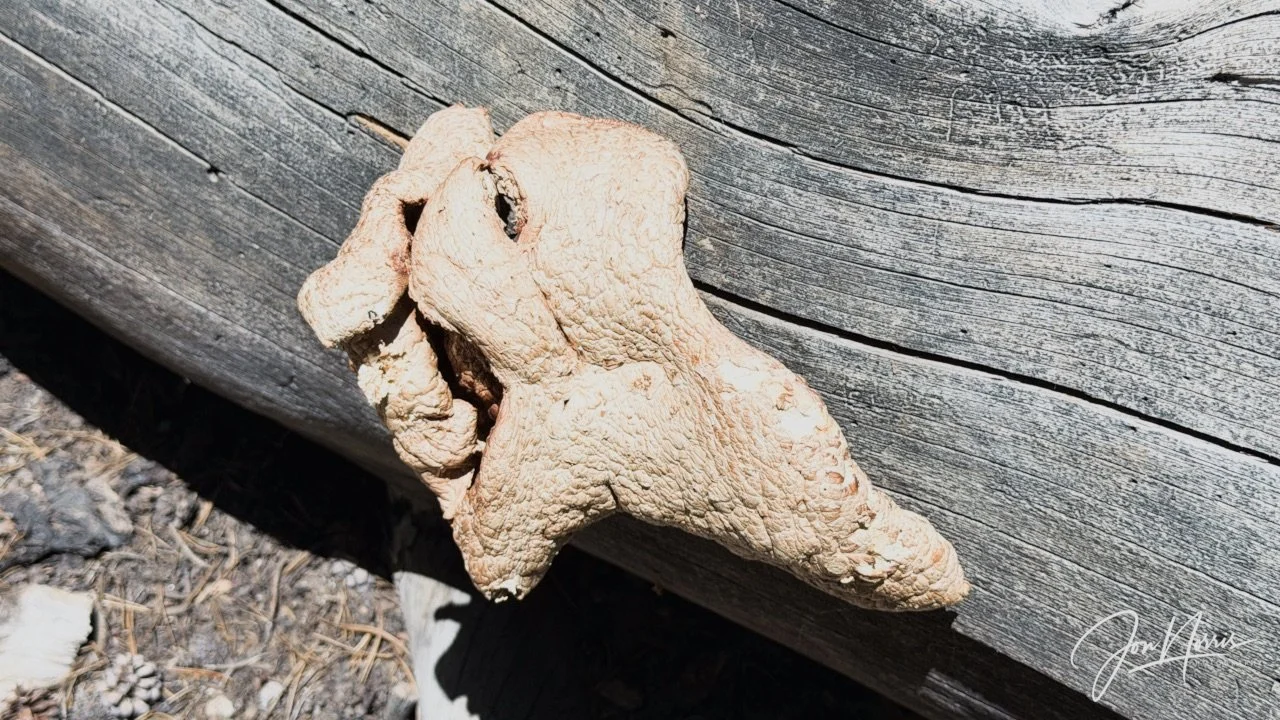
Giant Sawgill fungus (Neolentinus ponderous) | © 2026 Jon Norris
I’m a big fan of the app Seek, and used it extensively during the trip to identify flowers, trees and fungi (like the Giant Sawgill, above) that I spotted as I hiked.
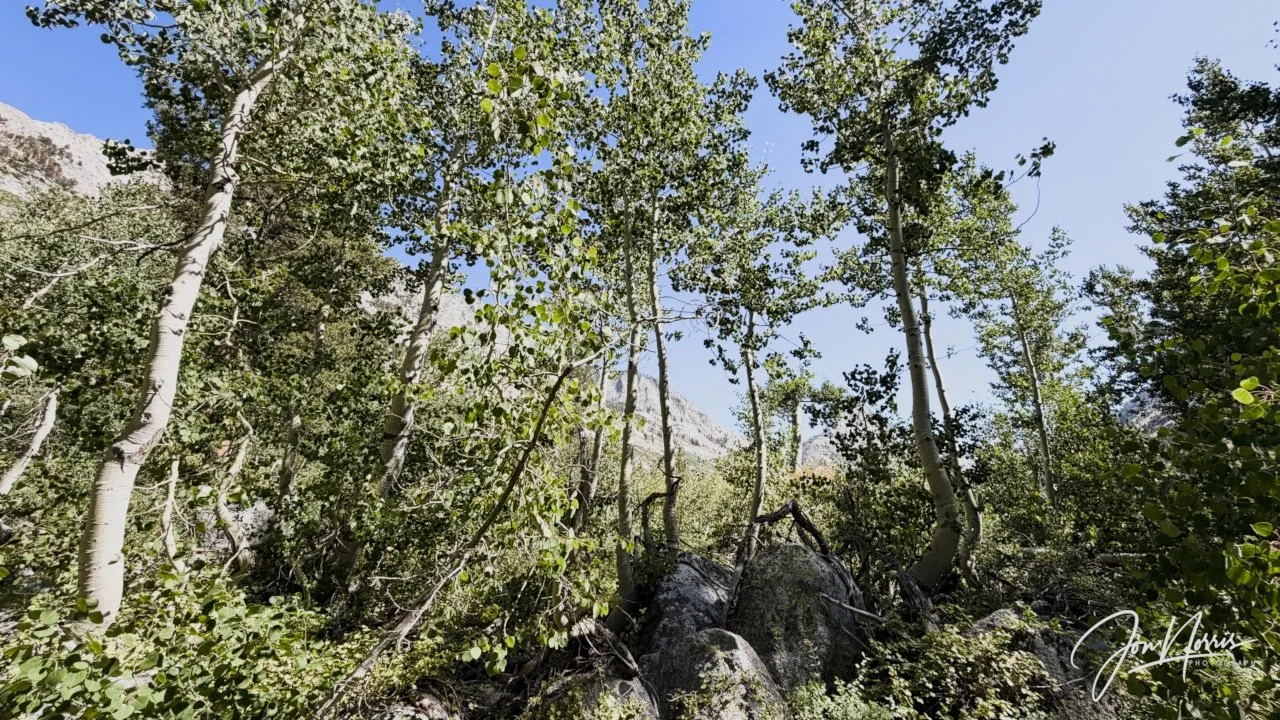
Video and Image: A grove of Aspen trees as the Cloud Canyon Trail meets Big Wet Meadow | © 2026 Jon Norris
After 2,200 feet of climbing the fir trees faded away, and we came across a grove of Aspen trees that marked the edge of Big Wet Meadow—the huge open sky beyond.
I don’t know if I was delirious at this point, but it seemed to me as if the Aspen leaves were waving at me—welcoming me to the meadow. The breeze was very welcome.
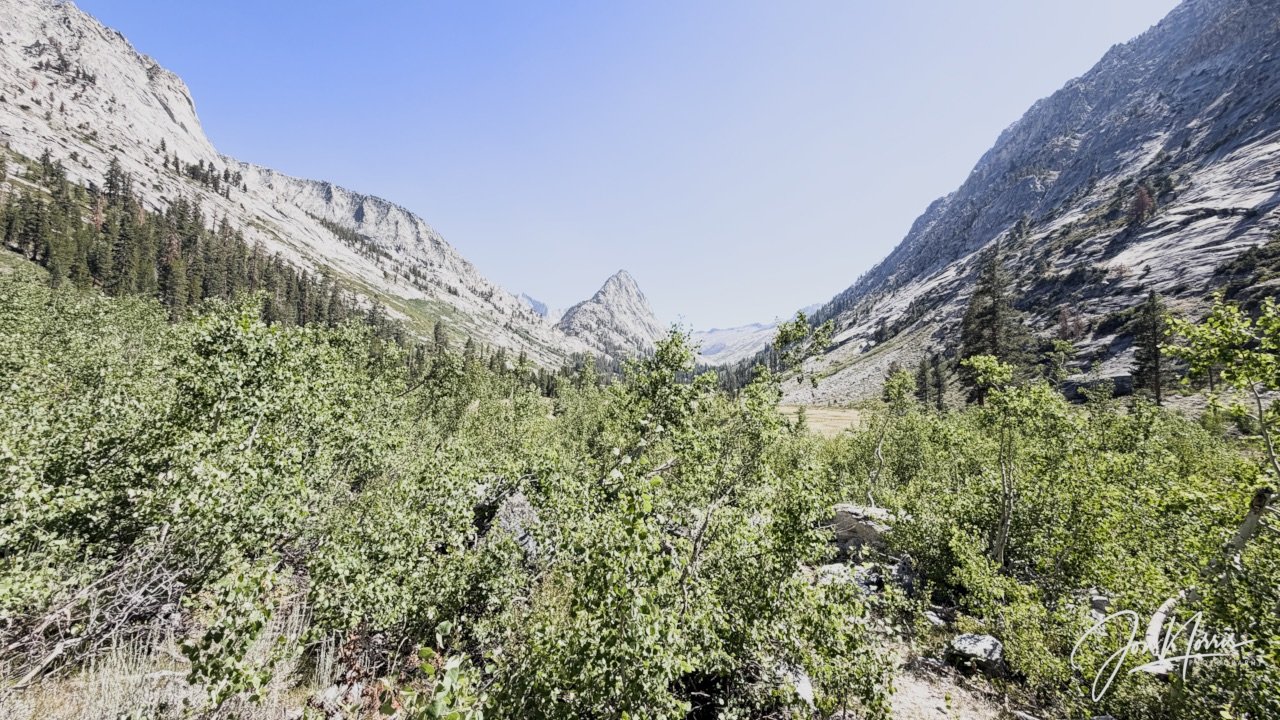
Looking along Big Wet Meadow towards Whaleback | © 2026 Jon Norris
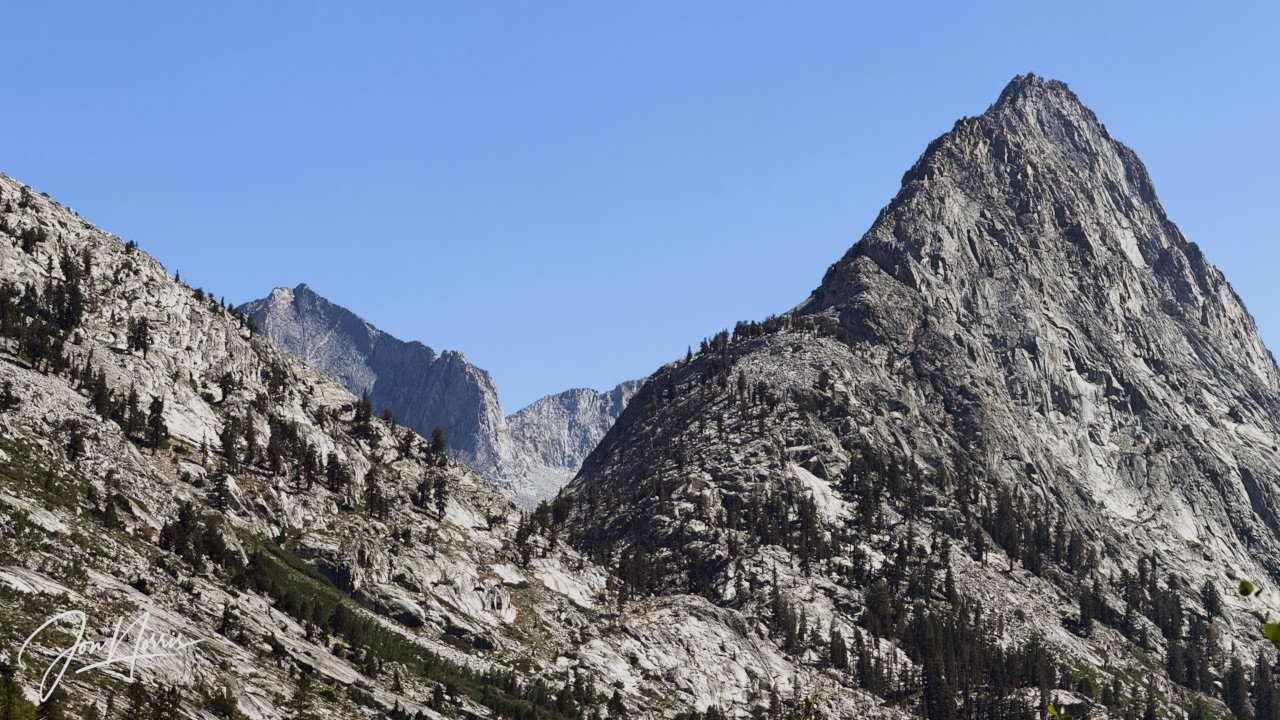
8X zoom to see Whaleback (on right) and on the left in distance the notch is Colby Pass at 12,000 feet | © 2026 Jon Norris
Beyond the Aspen Trees was a spectacular open view of Big Wet Meadow and in the distance the distinctive pyramid of the North end of Whaleback (11,722 feet). Our route on day 3 was going to take us to the left of Whaleback and then upwards towards Colby Lake (10,600 feet).
I zoomed in (with the iPhone at 8X) to get my first view of Colby Pass in the distance (the notch to the left of the Whaleback pyramid). From Big Wet Meadow, Colby Lake is hidden, and is in the col (the dip) before heading up to Colby Pass.
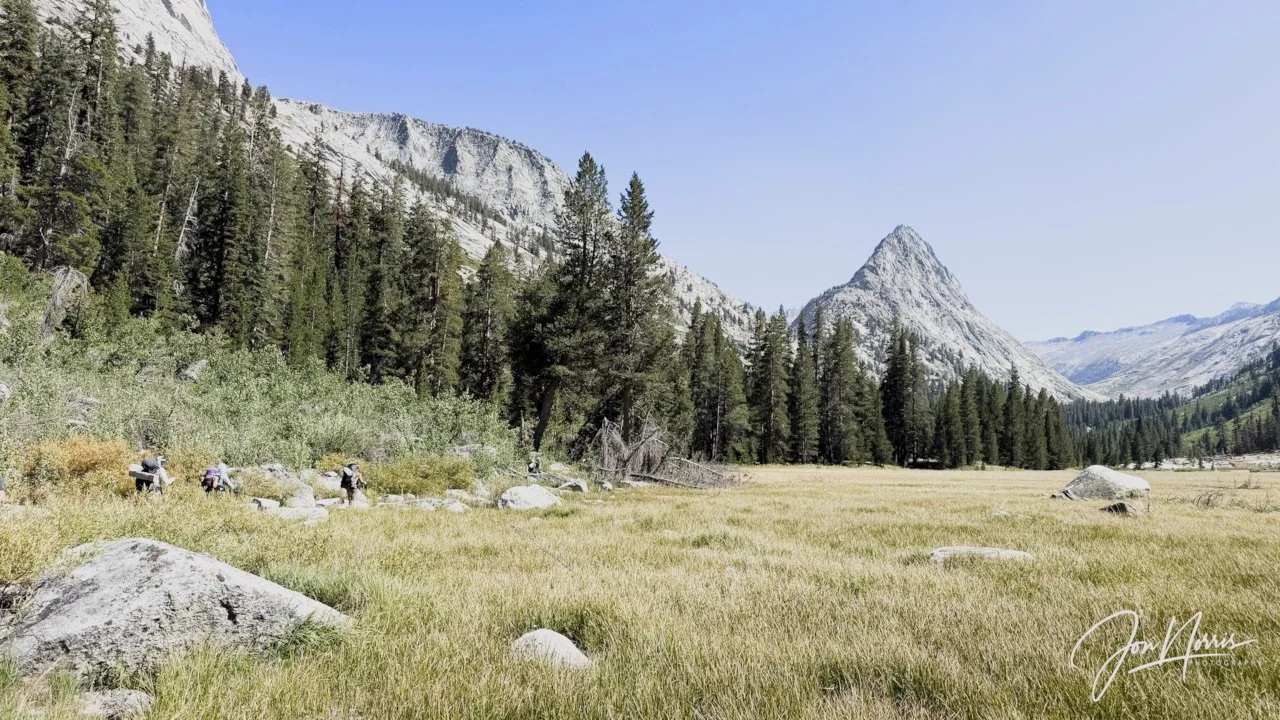
Walking towards camp in Big Wet Meadow after a long day on the trail | © 2026 Jon Norris
It was an exhausting day, and I was delighted to get to camp, and to take my backpack off. I spent a good 10-15 minutes in Roaring River having a stand-up bath of sorts and washing out my hiking clothes.
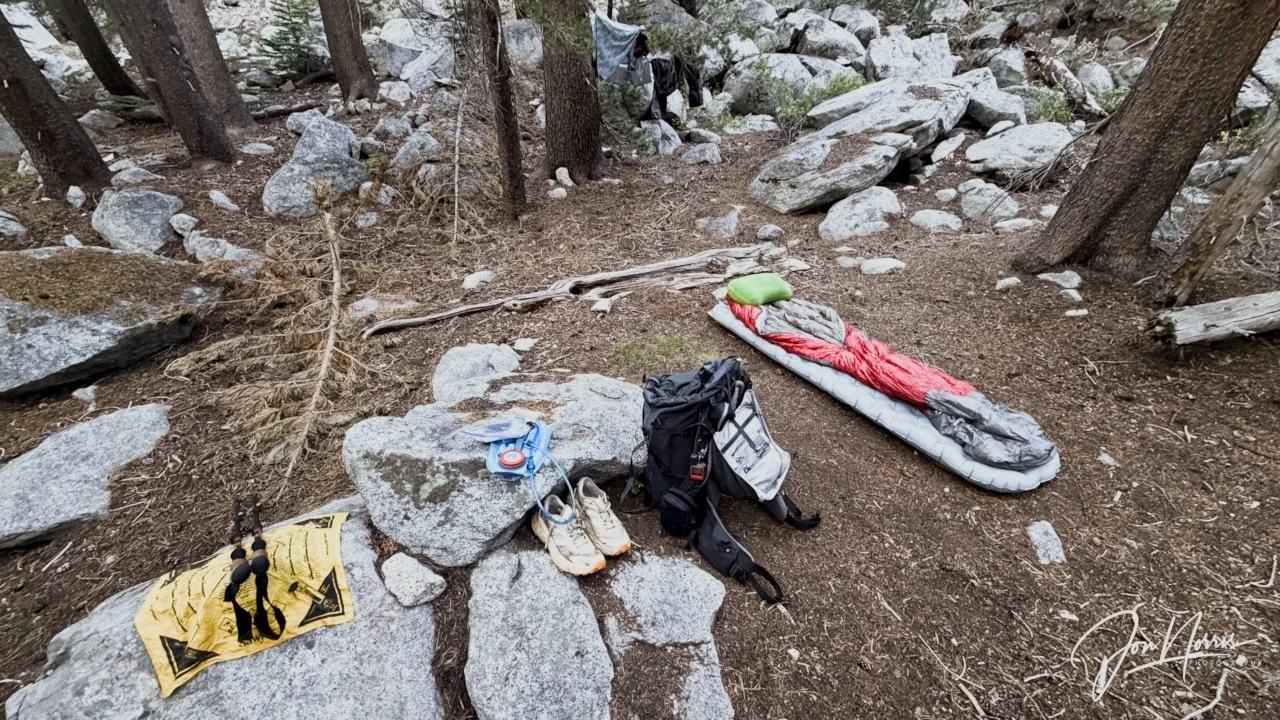
My bedroom for the night and first time cowboy camping | © 2026 Jon Norris
I found a nice flat area to claim as my own and decided that I was going to cowboy camp. My reasoning was that, 1) there were almost no mosquitos (which I was pleasantly surprised about), and 2) I really didn’t have the energy to put up my tent.
My last memory from the day (which was delightful) was drifting off to sleep, lying on my side, and looking up at the fir trees, with the last light of the day in the distance watching the color fade to black.
Till next time - and Day 3!
Day 2’s Camp Reflections
Prompts from Sydney Williams, with my responses.
Daily Reflections:
What did you notice outside yourself today? I noticed the wild flowers spread throughout the meadows that we hiked through. Red, white, yellow, orange, violet, pink. The meadows and flowers were thriving.
What did you notice inside yourself today? I found today much harder than day 1 and just couldn’t get myself into a comfortable pace. It didn’t help having all of the stops throughout the day to so we could regroup. I much prefer to find my pace that works for me and then stick to that.
Where did the landscape match your inner experience? Throughout the day the meadows (and wildflowers - as mentioned before) matched the fascination I was experiencing as I hiked through this incredible landscape.
Where did it challenge it? The last climb up through the wet meadow was hard going and full of bugs. That was challenging. I just wanted to be in camp and for it to stop. At the top of the last climb we stopped at a beautiful grove of aspen trees and that gave me a much needed physiological push, as did seeing the screeners opening up and getting my first glimpse of the Whaleback pyramid.
What moment from today do you not want to forget? Drifting off to sleep lying on my side looking up at the fir trees with the last light of the day in the distance. That was my first time cowboy camping (camping without a tent) - and it won’t be my last.
Theme Reflections:
What did it feel like to be held by this canyon, this river, this group, or this day? It was amazing to be immersed and ‘held’ by the incredible King’s Canyon landscape, and to experience that landscape unfolding before me as I hiked. Every few minutes, after each twist/turn, the landscape kept getting bigger and bolder.
Where did you receive support today, even if the day was still hard? I felt less than great today, however, there was always someone there to distract me from the physical effort, and offer a few words of encouragement. This kept me going.
If you could offer encouragement to a younger version of yourself, what would you want them to know? I would tell them to make the most of every single day - because you don’t know how many days you’re going to get.
Story Invitation:
What have you survived, grown through, or carried long enough to arrive in this “cradle” at this point in your life? I have carried being overweight most of my life and not in the best of fitness. I’m starting to show myself that I can do hard things like multi-day backpacking. I am determined to get fit (hiking fit) so that I can make the most of my 60s and 70s, and continue to explore the landscape.
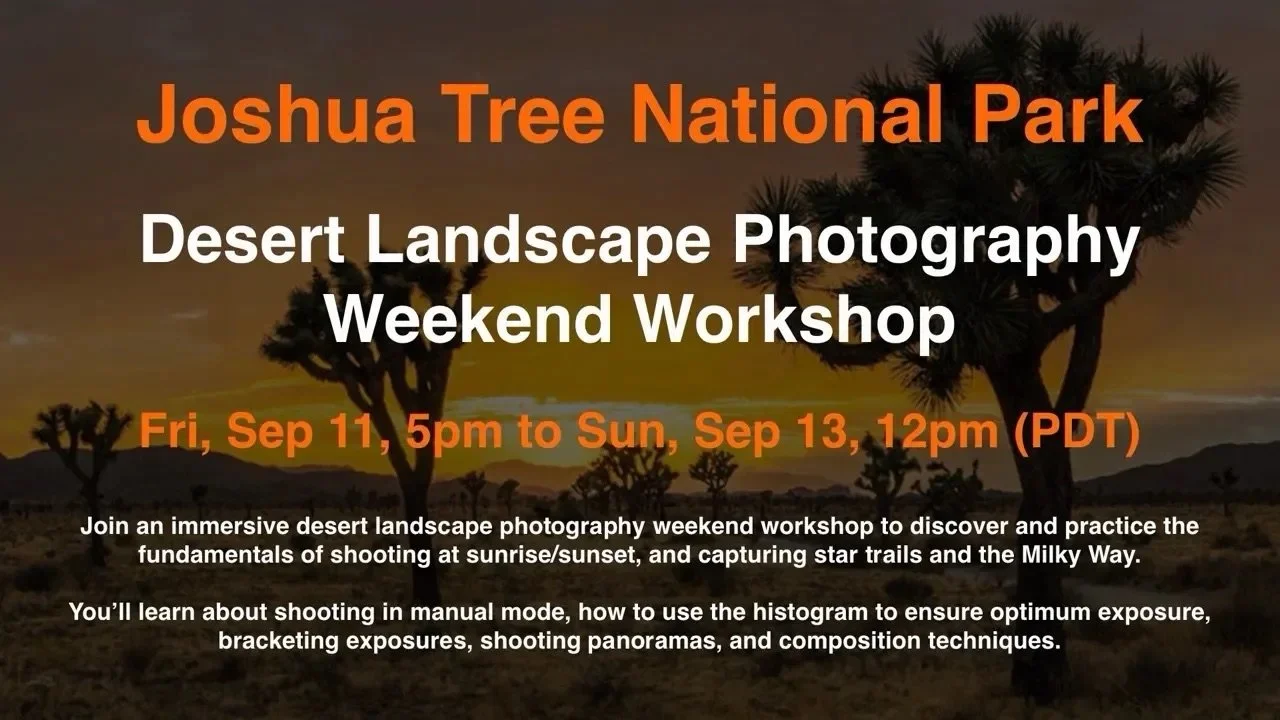
I’m delighted to be the instructor for next month’s Desert Institute (Joshua Tree National Park Association) desert landscape photography weekend workshop.
Join an immersive weekend landscape photography workshop and discover and practice the fundamentals of landscape photography. Topics covered will include shooting in manual mode, the exposure triangle, using the histogram to ensure optimum exposure, exposure bracketing, focus bracketing, panoramas, shooting in RAW, white balance and color temperature, understanding focus and depth of field, composition techniques, and more.
Whether you’re a beginner or looking to refine your skills, the friendly atmosphere of this workshop encourages creativity and collaboration. Discover the beauty of photography in a supportive setting, and leave with fresh techniques and new friends.
Here are five great reasons to attend this weekend landscape photography workshop:
Personalized Instruction: You’ll receive tailored guidance to elevate your photography skills, no matter your level.
Field Teaching: Dive into the fundamentals and advanced techniques during engaging field sessions that cover everything from composition to exposure.
Beautiful Locations: Experience breathtaking landscapes in Joshua Tree National Park, providing the perfect backdrop for your photography practice and inspiration.
Community Connection: Meet fellow photography enthusiasts, share tips, and forge lasting friendships in a supportive environment where creativity thrives.
Camp at the beautiful NPS Lost Horse campground which will be our base for the weekend.
