Explore Landscapes #103
Amboy Crater, formed of ash and cinders, is 250 feet high and 1,500 feet in diameter. It is situated in one of the youngest volcanic fields in the United States.
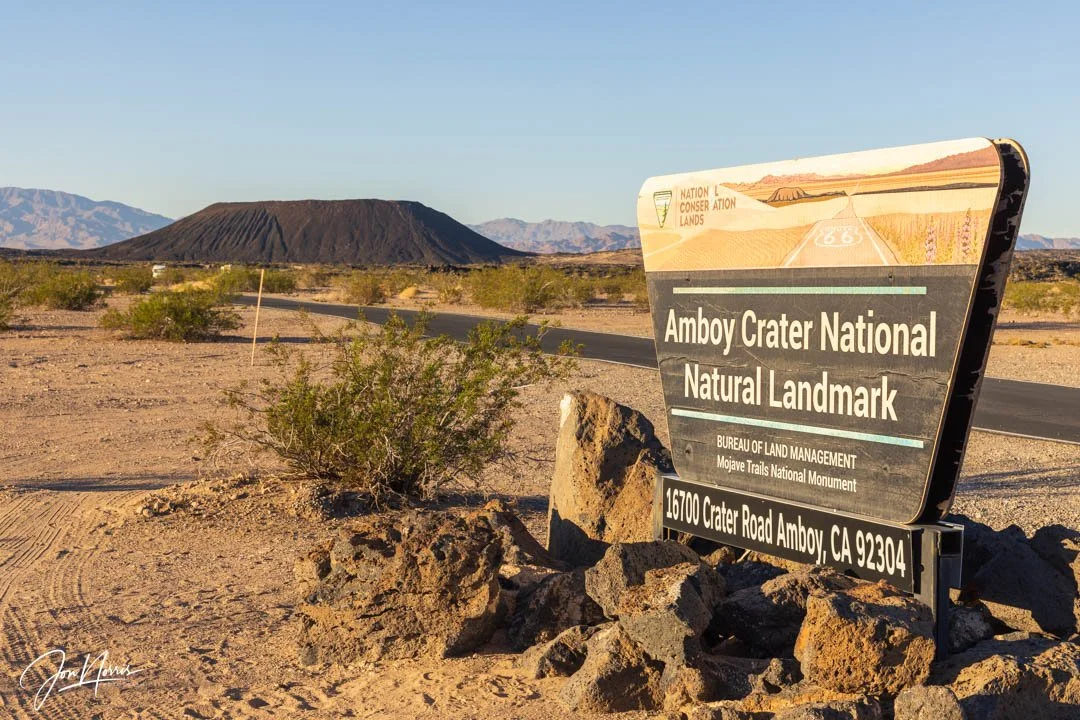
Amboy Crater National Natural Landmark | © 2025 Jon Norris
I recently volunteered for a Joshua Tree National Park Association’s Desert Institute field class that was held at the Amboy Crater National Natural Landmark.
Desert Institute - Classes, Activities, & Workshops
Since 1999, Desert Institute has connected park lovers of all ages with Joshua Tree National Park through adventure. DI provides a rich learning environment that fosters wonder, stewardship, and exploration for locals and visitors. Take a look at the DI website and browse through their line up of classes, activities and workshops.
Amboy Crater, formed of ash and cinders, is 250 feet high and 1,500 feet in diameter. It is situated in one of the youngest volcanic fields in the United States. It’s located in the Barstow-Bristol trough, a conspicuous west-northwest trending physiological feature which approximately straddles the Mojave and Sonoran tectonic blocks.
It’s about an hour’s drive North-East from Twentynine Palms (where the North Entrance to Joshua Tree National Park is located). You head out via Wonder Valley, bear left and then drive forty miles out into the desert, past natural mineral chloride beds, until you get to Route 66 (yes, the “get your kicks” Route 66). Fifteen miles before reaching Route 66 you can clearly see Amboy Crater in the distance.
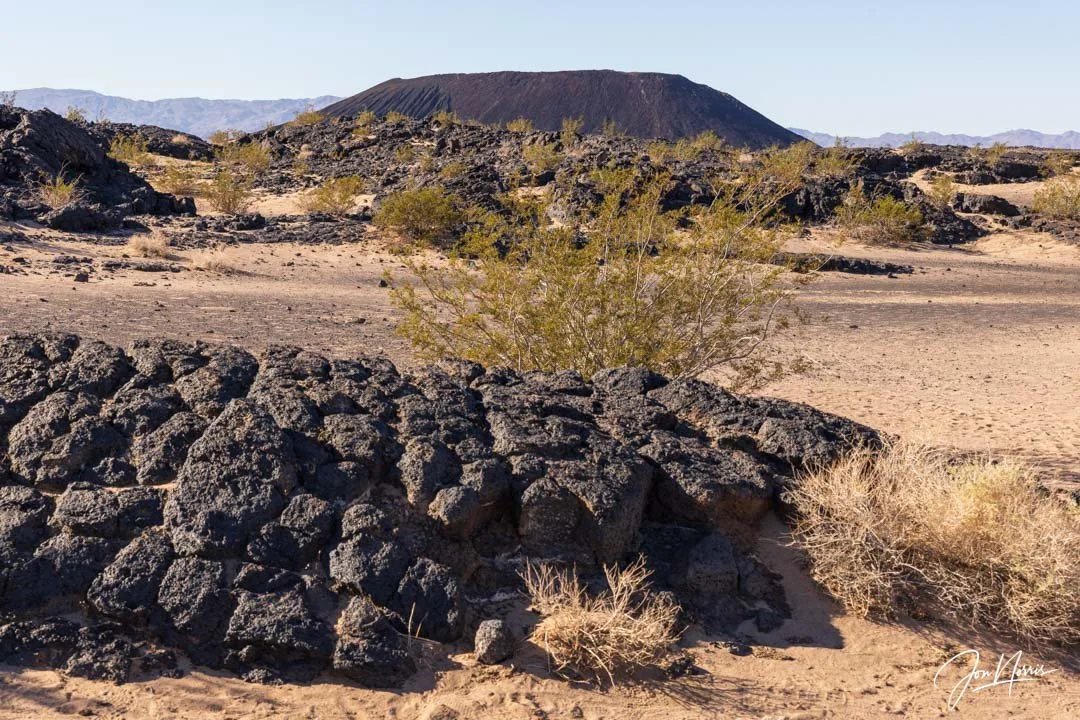
The edge of the lava field at the Amboy Crater National Natural Landmark | © 2025 Jon Norris
The lava field at Amboy Crater was created by at least 4 distinct periods of eruptions, resulting in a nested group of volcanic cinder cones. The most recent eruption of Amboy Crater was approximately 9,000 years ago.
The lava flows consist of basalt rich in minerals of magnesium, iron, and calcium. The red color indicates the presence of ferric iron and is a result of steam on heated rocks.
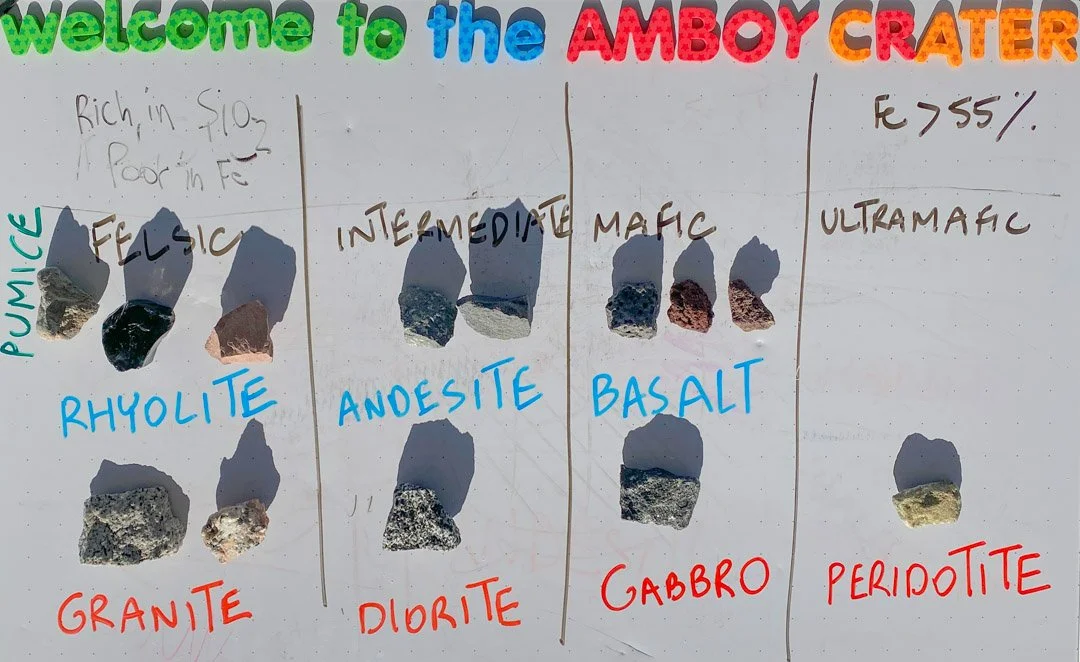
Field geology lesson on volcanic rocks with examples courtesy of our instructor, Alessandro Grippo
Our instructor for the field class was Alessandro Grippo (Ph.D., Geological Sciences, University of Southern California). Before we set out to hike to the crater, Alessandro gave us a fascinating introduction into the geology of volcanic rocks—clarifying some of the terms that we’d be hearing throughout the class.
All the rock samples on the white board above are volcanic rocks—and are formed through the cooling and solidification of magma or lava.
Igneous rocks can be split into two groups: intrusive rocks formed from magma which cools underground, and extrusive rocks where lava cools above ground. Intrusive rocks will have bigger crystal grains that are visible. Extrusive rocks will have small or microscopic crystals, or no crystals.
Intrusive and extrusive rocks can then be split into four different groups depending on the elements they contain: felsic (relatively rich in elements that form feldspar and quartz), intermediate, mafic, and ultramafic (richer in magnesium and iron).
Rhyolite (felsic), andesite (intermediate), and basalt (mafic) are extrusive igneous rocks. Note: ultramafic rocks are not formed above ground.
Granite (felsic), diorite (intermediate), gabbro (mafic), and peridotite (ultramafic) are intrusive igneous rocks.
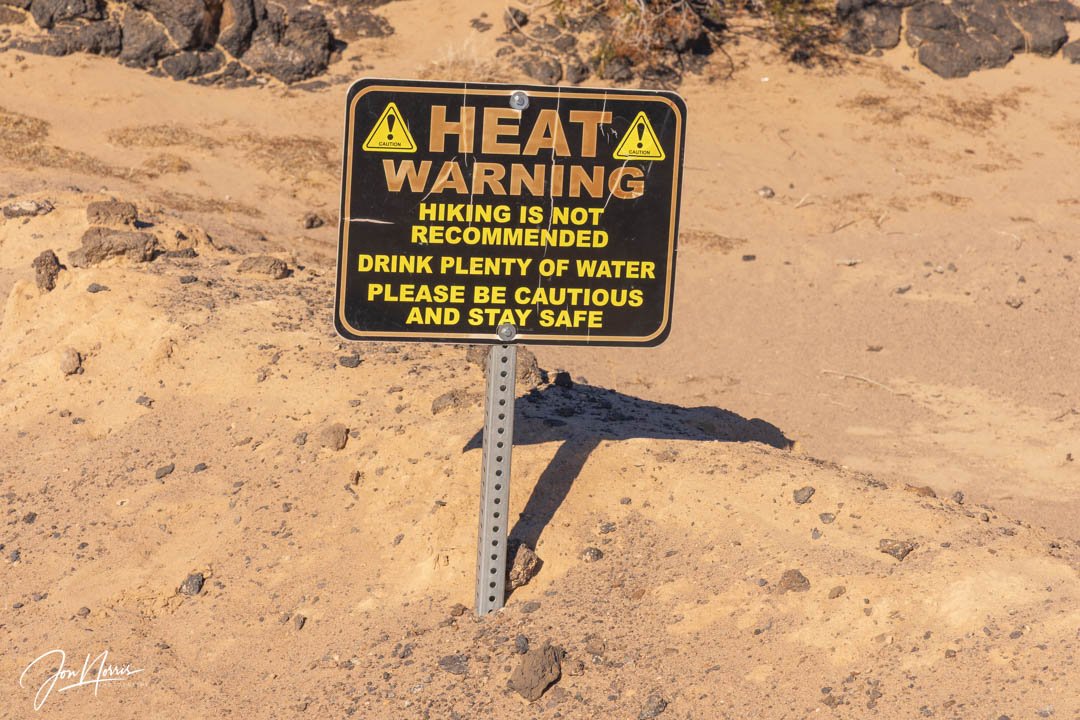
Hiking is not recommended | © 2025 Jon Norris
Due to the extreme heat, it is suggested that hikes be planned between the months of October thru April. We hiked to the crater on November 1st, and the temperature still peaked at 89°F (32°C).
If the hike to the crater doesn’t appeal to you, an ADA compliant shaded platform providing a scenic view of the crater is located 250 feet from the day use area at the trailhead.
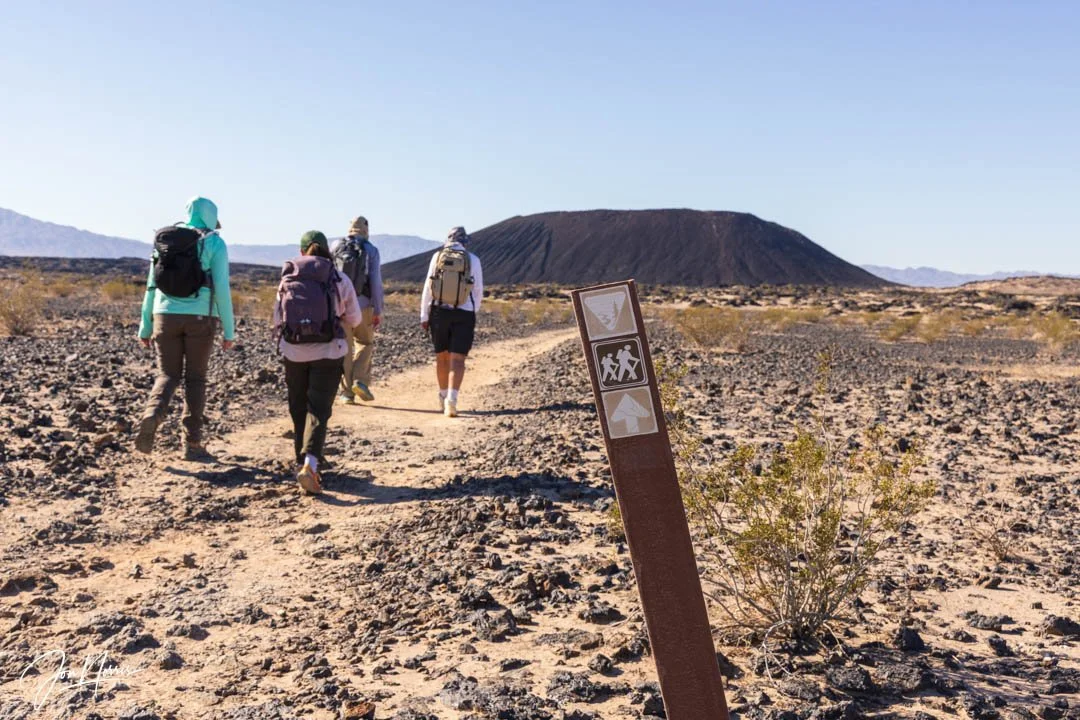
Following the trail towards Amboy Crater | © 2025 Jon Norris
The round trip hike to the crater is roughly 3 miles, with the trailhead just over a mile from the trailhead, and the cone is about a mile in circumference. We spent much of the time looking down on the ground to inspect the basalt lava flow and it’s various features.
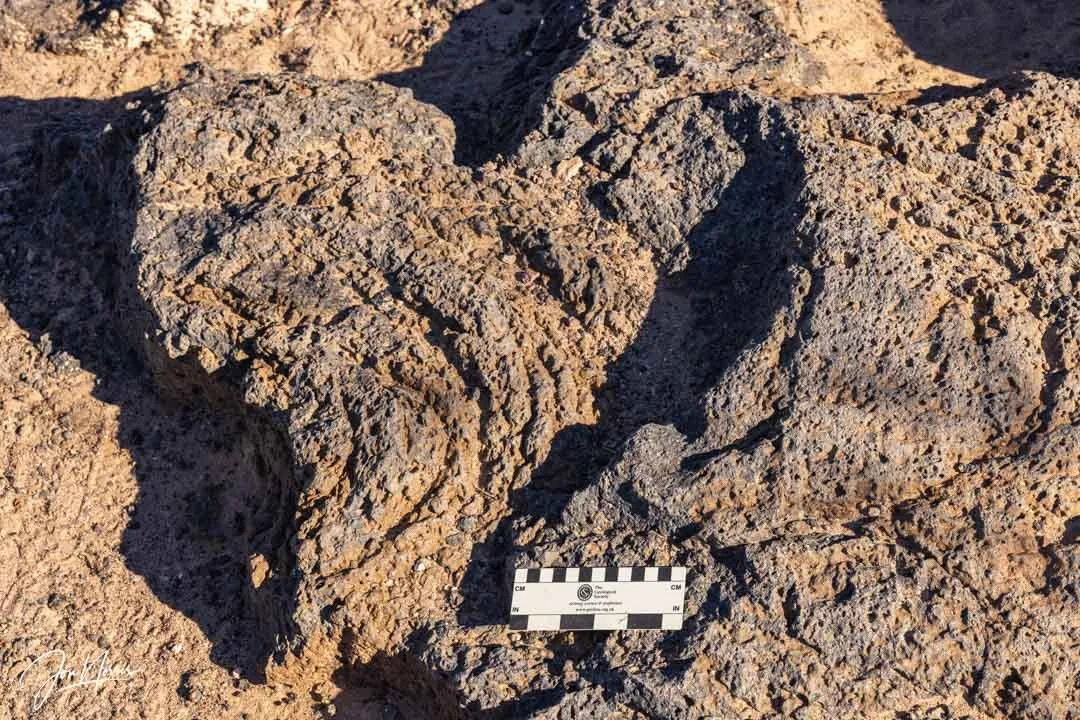
Pahoehoe Flow in the Basalt | © 2025 Jon Norris
Pahoehoe flow is created from a molten material that contained steam, making it flow more smoothly, creating a surface like rope with a glassy outer skin.
We also saw Jumbles, which are subsurface explosions that disrupted hardened lava flows, creating chunks of volcanic rock.
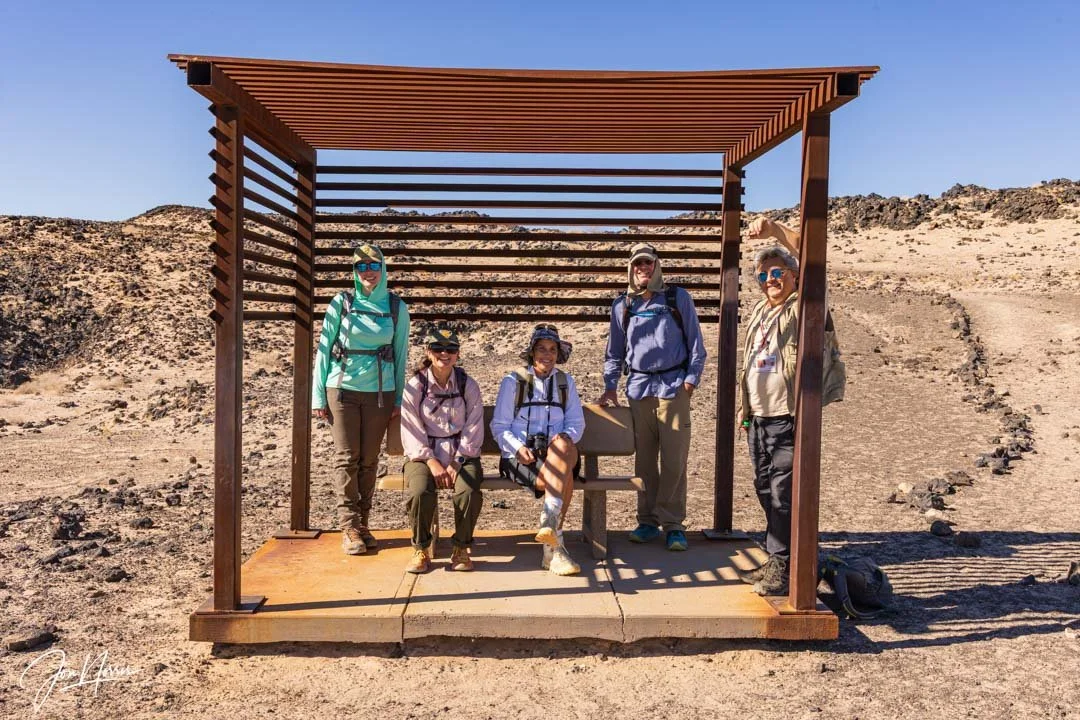
Taking a breather in the only shade (even if partial) between the parking lot and the rim of the crater | © 2025 Jon Norris
At a couple of locations between the trailhead and the crater were semi-shaded seating areas—which we took advantage of in both directions.
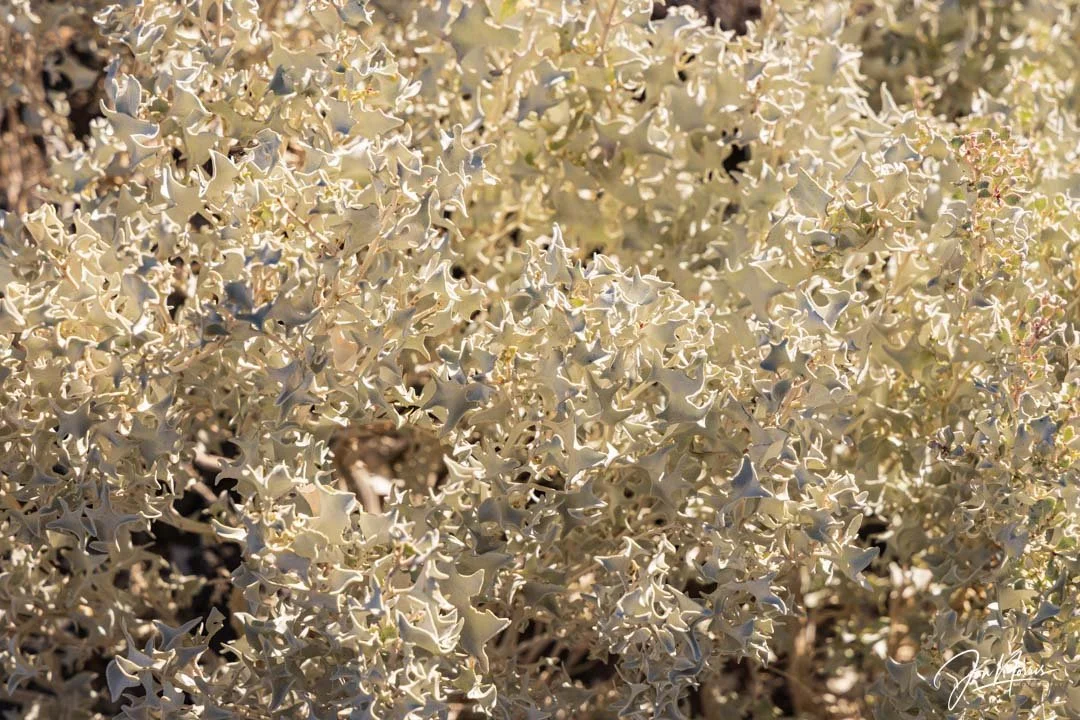
Desert Holly | © 2025 Jon Norris
Desert Holly (Atriplex hymenelytra) is a low elevation shrub with whitish, holly-shaped leaves. This plant is not a true holly, but rather, a member of the saltbush family so named because it is very tolerant to salty soil. It is found in washes and lava flows.
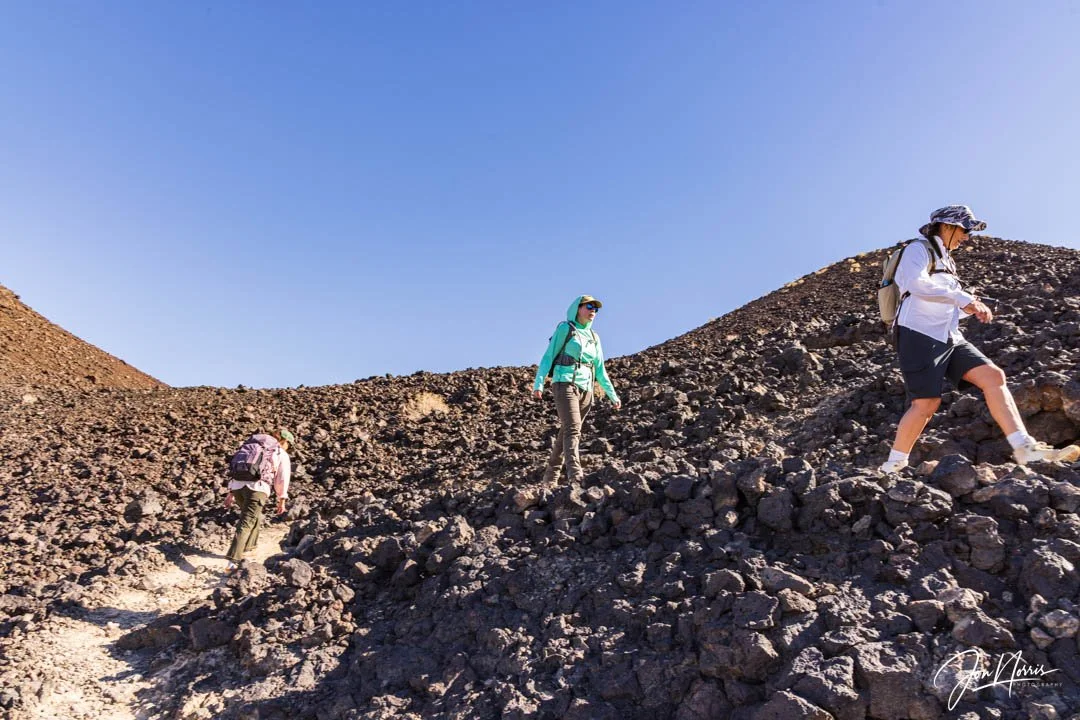
Switchbacks lead up to the breach in the Amboy Crater on the West side | © 2025 Jon Norris
The trail initially heads straight for the cone and then bears right and round to the West. This takes you to a wide opening where an explosive eruption breached the crater wall. From here, the climb to the top is an 80-foot (elevation) incline.
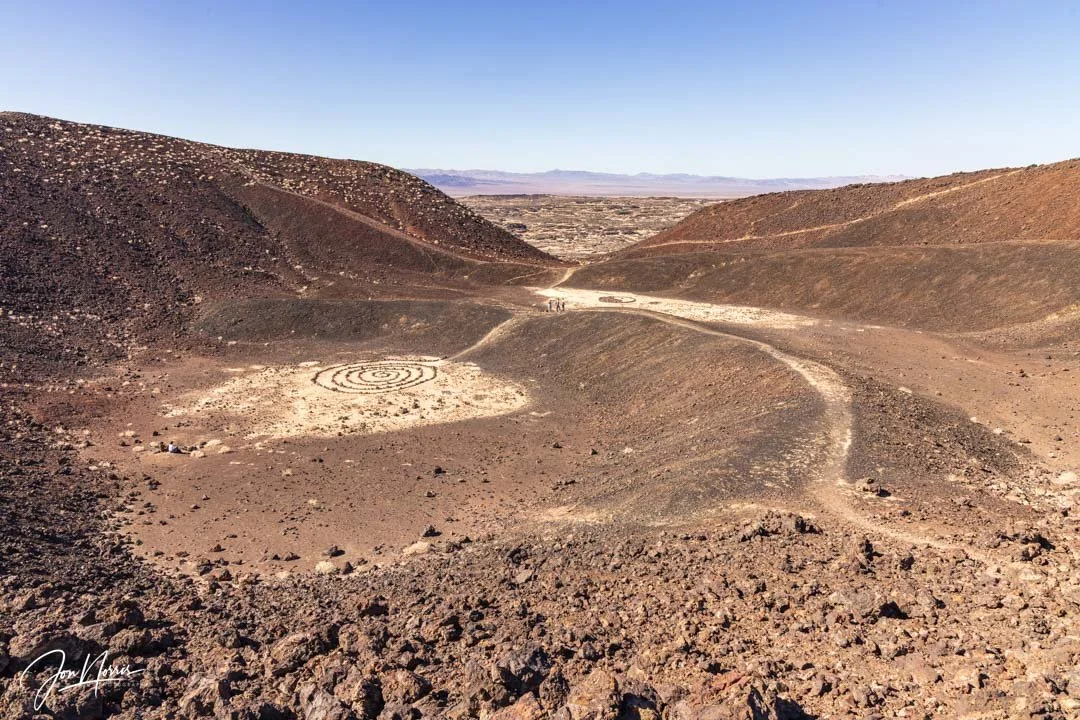
Looking down from the crater rim back towards the breach | © 2025 Jon Norris
I was saddened to see that ‘people’ had created a maze and a ying-yang symbol from rocks planted in an area cleared of the surface basalt to expose the underlying sand. This goes completely against the principles of Leave No Trace!
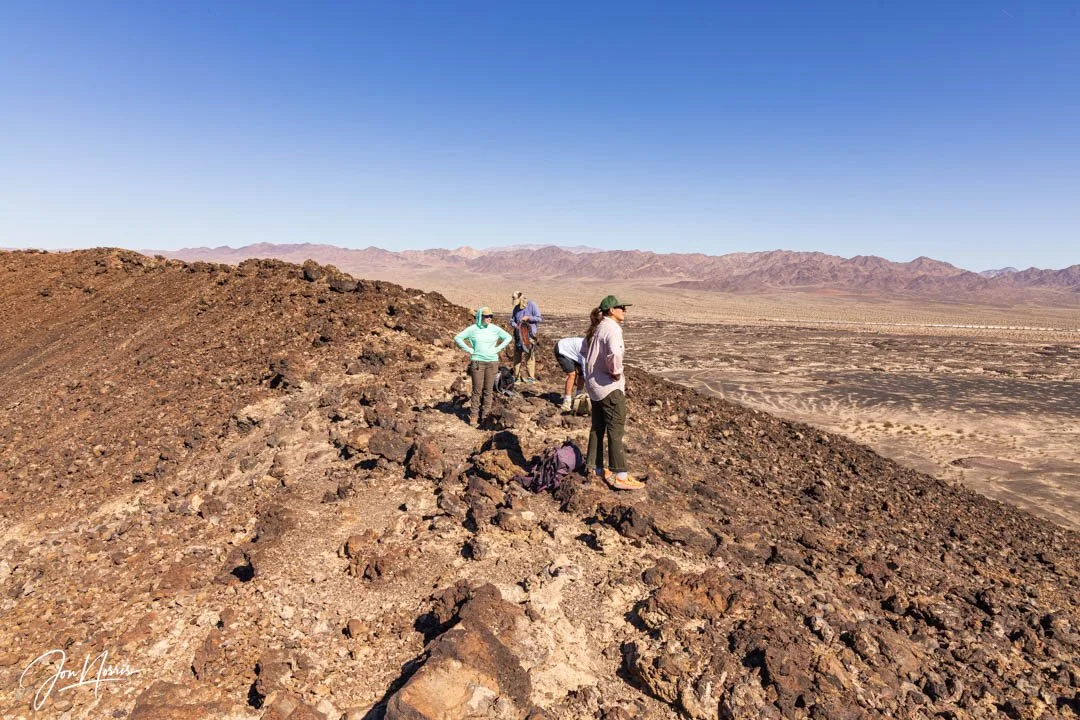
Not a bad spot to stop for some lunch! | © 2025 Jon Norris
By the time we got up to the rim of the crater we were more than ready for lunch—and what a lunch spot it was. The view across the lava field towards the Bristol mountains was breathtaking.
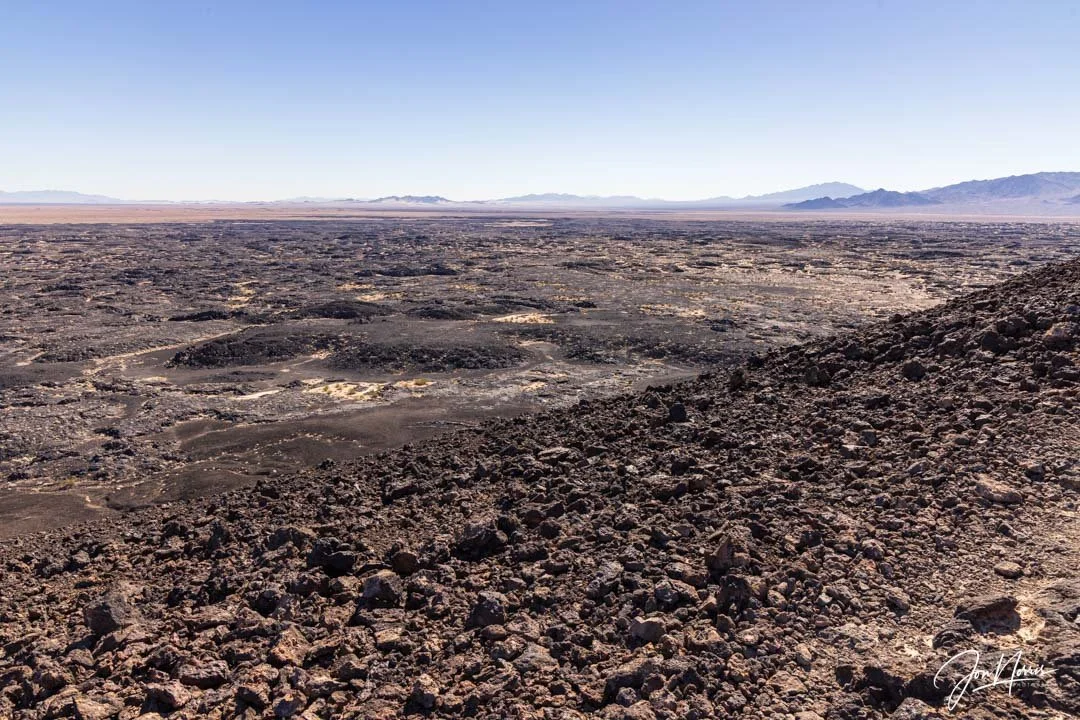
The lava field radiates in an almost perfect circle from the crater | © Jon Norris
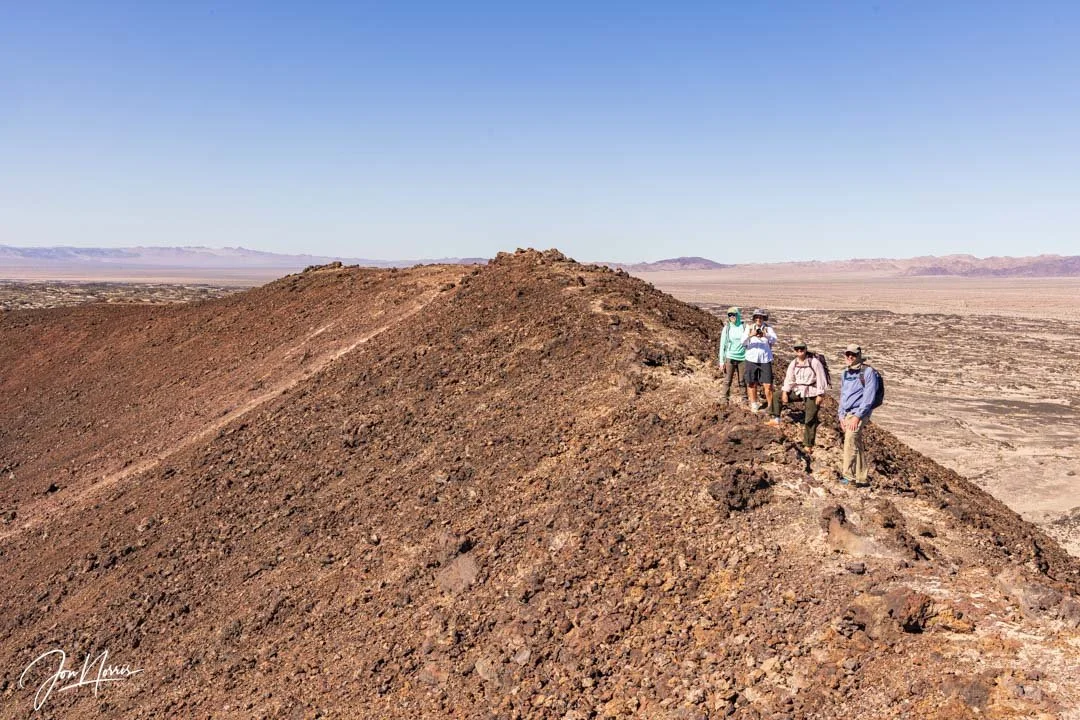
On the rim of the Amboy Crater | © 2025 Jon Norris
After a well-deserved lunch, we opted to walk around the rim (counter-clockwise) and then descended back down to the breach and out of the crater.
It was a fascinating day with a great group and I learnt so much about volcanic geology from Alessandro (our DI instructor).
I look forward to going back to Amboy Crater and am thinking that it would make a great location for astrophotography.
